
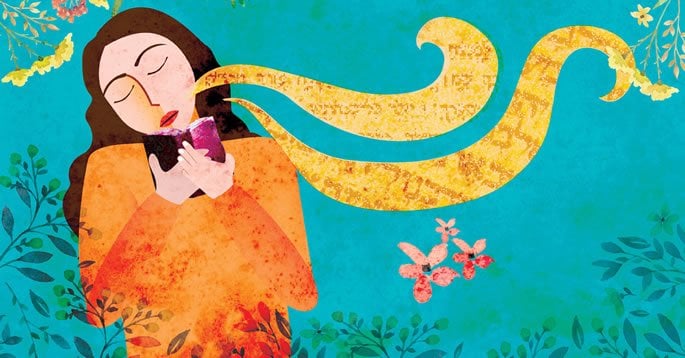
My relationship with prayer has not always been smooth.
As a child, I remember sitting in the aged care home where my father was the cantor on Rosh Hashanah, my mother giving me stern looks, silently telling me, “You must sit and pray.”
But my mind and body couldn’t do it. I couldn’t sit still for that long, couldn’t concentrate, couldn’t connect. The prayers felt endless and overwhelming. I longed to go outside, to breathe fresh air, to be anywhere but stuck inside for hours.
For many years, that feeling stayed with me.
But slowly, over time, something shifted. My resentment softened into curiosity, and I began to ask myself: Why is this so hard for me? What am I missing? What can I do differently?
Little by little, I built my own, softer, gentler relationship with G‑d. I stopped seeing Him as an angry, demanding G‑d, and embraced Him as a loving, caring Father I could speak to in my own way.
Prayer went from being something I had to do to something I wanted to do.
I still don’t pray for long stretches. My mind still wanders and my body fidgets. But I’ve learned to “nudge the needle.” When I say the Amidah, I focus on just one paragraph. Sometimes I read the English slowly and let the words settle.
And yes, sometimes my mind drifts so far it feels like I’ve landed in Italy, but then I gently bring myself back to Australia, to where I’m actually standing, and reset my focus. That, too, is part of the prayer.
Over time, prayer became my companion.
I’m a wig stylist, and if I’m dyeing a wig and it’s not going well, I pray. Before cutting a wig, I ask for success. When I go for a walk, I say Psalms. I speak to G‑d constantly—in Hebrew, in English, and often just in my own words.
And then there are moments—unexpected, powerful moments—that shape how I understand prayer.
One Rosh Hashanah in 2018, I was very unwell. I had a terrible migraine and was stuck in bed. My daughter left me a machzor so I could pray a little between resting. I knew I didn’t have the strength for much, so I asked myself: if I can say just one prayer today, which one should it be?
The Shema is powerful, but it’s something I say every day.
The Amidah felt too difficult; I didn’t have the strength to stand, and saying it while lying down didn’t feel right.
So I kept thinking.
Finally, I chose Hallel. What better way to crown G‑d as King than with joy, praise, and gratitude?
I opened my machzor… and couldn’t find Hallel. I assumed it must be a printing mistake. So I took a small Siddur from beside my bed, found Hallel, and sang it with all my heart, feeling deeply connected to G‑d and the holiday. It uplifted me.
Later, when my children came home, I told them proudly, “I chose the perfect prayer—Hallel!”
“Mum,” they said gently, “we don’t say Hallel on Rosh Hashanah.”
I couldn’t believe it. I even called my brother, a rabbi, the next day, and he confirmed it.
I felt foolish. Embarrassed.
But then, deep inside, I felt a quiet reassurance: “Sori, you should not have done it, but you can trust that G‑d loved your Hallel. It came from your heart. This year, this is the prayer that was meant to be said.”
Prayer is personal, and sometimes the most meaningful prayers are the ones that come from within.
I was once walking through a park, the sun warm on my back. Ahead of me, a woman and her young son hurried along, likely on their way to school. Suddenly, she stopped, turned toward the sun, and lifted her hands in a small gesture of gratitude. Her son copied her. Then they continued walking as if nothing had happened.
I was so moved that I ran after her. “Excuse me,” I asked, “what did you just do?”
“The sun felt so warm on my back. I just had to thank G‑d for it.”
I stood there for a moment and then said, “I’m Jewish, and I think I just learned a beautiful lesson from you.”
And then there are the quieter nudges.
It was Rosh Chodesh Tammuz. I had prayed Hallel and Mussaf that morning and felt calm and proud of myself.
Later that day, a thought entered my mind: “Sori, why don’t you pray Minchah (the afternoon service) today, to thank G‑d for such a beautiful day?”
“Okay, okay,” I answered, “just let me finish this wig.”
I started working and put on a podcast. The guest began speaking and said, “I always start with the words: ‘ה׳ שפתי תפתח ופי יגיד תהילתך - G‑d, open my lips and let my mouth relate Your praise,’” the opening sentence of the Amidah.
In that moment, I didn’t need anything more. “Yes, G‑d,” I thought, “I hear You.” And I began Minchah.
Because that’s what prayer has become for me. No long hours and pressure for perfection, but a real relationship. A conversation that weaves throughout my day.
And every now and then when I lose sight, He gifts me a moment—a whisper, a nudge, a burst of clarity—that reminds me: Just speak. Connect. That’s all G‑d really wants.





I love this so much!! Thank you!