

Reading the Torah, Keriat HaTorah, is one of the central institutions of Jewish communal worship. Beyond the obligation to hear the Torah read publicly, the reading itself must be conducted according to a detailed set of halachic guidelines governing the Baal Koreh (Torah Reader), the Torah scroll, and the congregation. In this article, we will discuss some of the practical laws that arise during the Torah reading, including how the Baal Koreh should conduct the reading, when reading mistakes must be corrected, how to proceed when an error is discovered in the Torah scroll, and other situations that commonly arise.
While many of these laws involve intricate details, the focus here is on the basic principles and practical guidelines relevant to the public Torah reading.
What If the Baal Koreh Is in the Middle of Praying?
If the Baal Koreh is in the middle of his own prayers when it is time for the Torah reading, and there is no one else present capable of reading the Torah properly, he may serve as the Baal Koreh even if he is in the middle of reciting Shema or its blessings.1 He may not, however, interrupt in the middle of the Amidah in order to read the Torah.
In such a case, his permission extends only to the actual Torah reading. He may not perform other functions associated with the Torah reading, such as calling up the aliyot, reciting the Mi Shebeirach prayers, or making other verbal announcements. These duties should be performed by someone else.2
Procedure Before Reading the Torah
Nowadays, the common custom is that the one reading the Torah, the Baal Koreh, stands to the left (facing the front of the synagogue), and the one receiving the aliyah, the “Oleh,” stands to his right.3
Before beginning the Torah reading, the Baal Koreh should show the Oleh the place from which the aliyah will be read.4 In some communities, including Chabad, it is customary to show both the start and end point of the reading.5
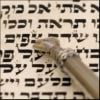
When pointing out the place to the Oleh, care should be taken not to directly touch the actual parchment of the Torah scroll.6
If the Baal Koreh accidentally points to the wrong place and the Oleh has already recited the blessing, a distinction must be made. If the correct reading was open before the Oleh and the Baal Koreh merely pointed to the wrong column or section, a new blessing is not required. If, however, the place indicated was entirely different and not even within the section to which the Torah scroll was opened, the blessing is considered to have been recited on the wrong reading, and a new blessing must be recited.7
For the laws of the one getting the aliyah see: What You Need to Know About Getting an Aliyah
Answering Amen at the Proper Time
It has become customary in many communities for the Baal Koreh to answer amen loudly and to prolong it slightly more than the congregation in order to signal that the Torah reading is about to begin and draw everyone's attention to the reading.8
Nevertheless, care should be taken that the Baal Koreh begin reciting amen together with the congregation. Amen should be said immediately upon the conclusion of the blessing, and one should not delay its recitation.9 Accordingly, while the Baal Koreh may prolong the amen after beginning it together with everyone else, he should not wait to start answering later than the congregation.10
The Torah Portion Must Be Read From the Scroll
The Baal Koreh must read directly from the Torah scroll and may not recite even a single word from memory.11
If the Baal Koreh reads a word or two from memory, after the fact the reading remains valid as long as those words do not convey an independent phrase when read on their own. If, however, he reads an entire verse from memory, or even several words that form a complete phrase with independent meaning, that portion of the reading is invalid and must be reread from the Torah scroll.12
When Should a Baal Koreh Be Corrected?
If the Baal Koreh mispronounces a word in a way that changes its meaning, he must be corrected and repeat the word properly.13 Likewise, if he reads the ketiv instead of the keri, he must be corrected.14
If the mistake does not change the meaning of the word, the Ashkenazic custom is not to have him repeat it. The same applies to an error in the tune or cantillation that does not change the meaning. Nevertheless, the mistake should be brought to his attention discreetly.15
(In Sephardic communities following the Shulchan Aruch, the custom is to correct a mistake in reading even if it doesn’t necessarily change the meaning. However, they don’t necessarily correct a mistake in the cantillation.16 )
Some17 are careful to correct even slight pronunciation or cantillation errors, as was the practice of the Alter Rebbe.18 However, this is not the general directive for public Torah reading.19
When the error does not affect the validity of the reading, such as a minor pronunciation or cantillation mistake, only those close enough to correct the Baal Koreh discreetly should do so. Calling out across the synagogue can cause unnecessary embarrassment and should be avoided.20
In all cases, if the Baal Koreh notices the mistake immediately, or someone quietly alerts him before he continues, he may correct it on the spot, even when the error does not affect the meaning.
What Is or Isn’t Required to Be Corrected?
Examples of errors that require repetition include saying חָלָב (chalav—milk) instead of חֵלֶב (cheilev—forbidden fat), or יַעֲשֶׂה (ya'aseh—he will do) instead of יֵעָשֶׂה (yei'aseh—it will be done), as these alter the meaning of the word. Likewise, one who reads the ketiv (how the word is written) instead of the keri (how it is meant to be read) must be corrected.21
In contrast, errors such as saying אֵת (eit) instead of אֶת (et), or מִצְרָיִם (Mitzrāyim—with a kamatz under the ר) instead of מִצְרַיִם (Mitzrayim—with a patach under the ר), do not require repetition, since the meaning remains unchanged.22
The same applies to omitting a mapik hei or reading a sheva na as a sheva nach, or vice versa. Similarly, if the Baal Koreh places the accent on the wrong syllable (milra instead of mil'eil, or vice versa), he is not required to repeat the word if the error merely changes the tense from past to future or vice versa. If, however, the incorrect accent changes the actual meaning of the word, it must be repeated.23
From Where Is the Reading Repeated?
When a word must be repeated and the mistake is noticed immediately, the Baal Koreh repeats only the mispronounced word and continues from there.24
If the mistake is discovered only after he has continued reading, he returns to the beginning of that verse and rereads it correctly. If the error is discovered much later, after the aliyah has concluded, at the start of the next aliyah he returns to the beginning of the affected verse and continues reading through the current aliyah.25
If the verse contains G‑d’s Name, he returns to the beginning of the verse. Many have the custom to first complete the verse and then reread it from the beginning.26
If it is a mistake that does not require correction and he has already recited G‑d's name, he should not correct the mistake (i.e., although ordinarily he may correct even mistakes that aren’t technically required to be corrected) in this instance, he should just keep reading.27
What If the Error Is Discovered After Keriat HaTorah?
If an invalidating mispronunciation is discovered only after the entire Torah reading has concluded and the last concluding blessing has been recited, some authorities rule that the Torah is not taken out again.28
What If the Wrong Torah Portion Was Read?
If the wrong Torah portion was read, the law depends on the occasion.
If the error occurred during the Shabbat morning reading or during a special holiday reading—including Chanukah, Purim, and other occasions with a designated Torah reading—the congregation must reread the correct Torah portion and fulfill all the requirements of that reading, including the proper number of aliyahs.29
If, however, the wrong portion was read on Monday, Thursday, or Shabbat afternoon services, the reading generally does not need to be repeated. Nevertheless, if the mistake is discovered before the reading has been completed—for example, between aliyahs—the remaining aliyahs should be read from the correct Torah portion.30
If a public fast day falls on a Monday or Thursday and the wrong Torah reading was read during morning services, there is halachic basis to rely on the reading already performed and not require the Torah reading to be repeated.31 This leniency applies only to the morning reading on a Monday or Thursday fast day. It does not apply to the afternoon reading of a fast day, nor to fast days that occur on other days of the week.
What If a Mistake Is Discovered in the Torah Scroll Itself?
The halachic procedures that apply when an invalidating error is discovered in a Sefer Torah are subject to significant debate among halachic authorities. In practice, different communities follow different rulings regarding whether the reading should continue, when a replacement Torah scroll should be brought, and how the aliyahs are to proceed. The guidelines below follow the rulings of the Tzemach Tzedek, as recorded in his responsa.32 In any practical case, a competent rabbi should be consulted.33
When No Other Torah Scroll Is Available
If no other Torah scroll is available and the defect is located in a different Chumash than the one currently being read, the Torah may still be used even initially. Thus, if an error is discovered during the Shabbat morning reading in a different Chumash, the same Torah may still be used later for the Shabbat afternoon reading when no replacement Torah is available.
As a general rule, when no replacement Torah is available, the reading is not discontinued because of a discovered error. Rather, the required aliyahs are completed and each Oleh recites the blessings as usual. On Shabbat, however, the seventh Oleh also serves as Maftir. (Whenever the seventh Oleh also serves as Maftir, Kaddish is recited only after the Haftarah is read).34
When Another Torah Scroll Is Available
If a definite error is discovered between aliyahs, the Torah scroll should be replaced before the next aliyah begins.
If the error is discovered during an aliyah, the reading should continue only until the earliest halachically permissible stopping point. If at least three verses have already been read and the reading is not within three verses of a parshah pesuchah or setumah, the reader completes the current verse, the Oleh recites the concluding blessing, and the Torah is replaced. If fewer than three verses have been read, the reader completes three verses, the Oleh recites the concluding blessing, and the Torah is then exchanged.
If the error is discovered during the seventh aliyah on Shabbat, the seventh Oleh completes the remainder of the portion in the invalid Torah. No separate Maftir is called up; rather, the seventh Oleh also reads the Haftarah, and the Torah is not replaced.
When Two or More Words Are Missing
A different procedure applies when two or more words are missing from the Torah text (see footnote).35
In all cases, the aliyos previously read from the invalid Sefer Torah remain valid and do not need to be repeated.36
What Is Considered a Mistake in a Torah Scroll?
Common examples of potentially invalidating errors include an incorrect parshah pesuchah or setumah break, where a section of the Torah is not spaced properly; a misspelled or repeated word; letters that touch in a way that changes their appearance or makes them difficult to identify; a hei or kuf whose leg is connected to the roof of the letter; or a letter that is split in a manner that compromises its form. Improper spacing can also be problematic, such as when two words are written so closely together that they appear to be one word, or when the letters of a single word are spaced so far apart that they appear to be separate words.37
By contrast, differences in chaser and yaseir spelling generally do not invalidate a Torah scroll if the pronunciation and meaning of the word remain unchanged. Chaser (“deficient”) and yaseir (“full”) refer to whether a word is spelled with or without an extra vav or yud. Since many words can be written both ways without affecting how they are read, such variations are generally not considered invalidating.38
The laws governing the validity of a Torah scroll are highly intricate, and many apparent errors do not necessarily render a scroll invalid and are beyond the scope of this article. Accordingly, whenever a possible mistake is discovered, a competent rabbi or qualified scribe should be consulted before determining the status of the scroll. The above examples are merely some of the more common issues to be aware of.
Reciting Half-Kaddish
After the Torah reading is completed, the Baal Koreh recites Half-Kaddish.39 Many communities, including Chabad,40 have the custom that when applicable, a mourner or someone who has a yahrtzeit that day recites this Kaddish.41
When there is a Maftir aliyah that is separate from the obligatory aliyahs—as is the case on Shabbat morning and most holidays—Half-Kaddish is recited after the completion of the obligatory aliyahs and before Maftir. In this instance, the Kaddish serves as a separation between the main Torah reading and the Maftir reading.42
On occasions when Maftir is counted as part of the required aliyahs and is not a separate addition, such as, for example, afternoon services on a fast day, Half-Kaddish is not recited before Maftir. 43


Start a Discussion